
The Right Answer for Right Now
Fifteen years in, Salesforce is still the platform we’re betting on
Part 6 of The Accidental Agentic Enterprise series. [Start with Part 1 here.]
Author: John Pettifor
 The first time I logged into Salesforce, the internet still made noises when it connected. Fifteen years ago I was learning a CRM that, by today’s standards, was barely more than a glorified address book and pipeline tracker. A handful of standard objects. Sluggish behaviour at any real data volume. A reporting engine you babied if you didn’t want it to time out. I loved it anyway, and I bet a career on it.
But I want to be careful not to be too dismissive about that early version, because it’s easy to forget what it actually was at the time. Most enterprise software still shipped on CDs in shrink-wrapped boxes. And Marc Benioff and Parker Harris were already betting that real businesses would run their most important applications over the internet, on someone else’s servers, paid for monthly, accessed through a browser. They called it No Software. They were essentially pioneering enterprise cloud computing as a category, and they shipped one of the first commercial web service APIs the industry had ever seen alongside it. The product I logged into a decade later might have felt limited, but the idea behind it was one of the most consequential bets in the history of business software. The fact that Marc and Parker are still here, still shipping, still pushing the platform forward more than twenty-five years later, is one of the more remarkable consistency stories in technology.
I think about that often when I look at what’s running in our environment today.
What Salesforce became
The Salesforce I started on couldn’t have run the agentic enterprise we have now. It wasn’t even close. What changed wasn’t one thing. It was a long, deliberate series of bets that turned a CRM into the front office, then the back office, and now the operating layer for AI itself.
The acquisitions are the easiest way to see the arc. Heroku in 2011 brought a real platform. ExactTarget made marketing native. Tableau gave the platform analytics that didn’t feel bolted on. MuleSoft in 2018 was the integration story that meant Salesforce stopped being an island. Slack in 2021 became the conversational surface that the rest of the platform now happens through. Informatica, closed in late 2025, brought the data governance and master data layer the agentic era was always going to need.
Salesforce’s integration discipline doesn’t get enough credit
What I’ve always been impressed by, and what I think doesn’t get talked about enough, is what Salesforce does after the deal closes. Most acquirers buy companies to get their customers. Salesforce buys companies to use their IP. There’s a real difference. MuleSoft is still MuleSoft seven years in. Tableau is still Tableau. Slack is still Slack. But the integration work behind each one has been deep and patient. Identity, security, data, billing, and now the agent fabric all stitched together so that what looks like a portfolio of acquired products on paper actually behaves like a single platform in production. That kind of integration discipline is rare. It’s the reason these acquisitions add up to something instead of sitting next to each other in a logo slide.
You can argue about price tags. You can argue about timing. You can’t argue with the result: a stack where connectivity, data, action, governance, and human collaboration all live under the same roof, with the same identity model, the same security posture, and increasingly the same agent fabric.
Every one of those acquisitions shows up in what Diabsolut runs today. MuleSoft Agent Fabric is the concierge layer the architecture post in this series spent ten minutes explaining. Slack is where our agents actually meet our people. Data Cloud, now part of the broader Data 360 story, is the harmonization layer that makes any of this defensible at scale. And we’re starting to explore Informatica as the next layer in our governance story, because the data trust problem is the one we want to be ahead of, not behind. None of this was inevitable. Someone had to buy the right pieces, in the right order, and put in the work of integrating them properly. Salesforce did.
The other platform stacks are real
I want to be careful here, because the agentic enterprise conversation gets tribal fast and that doesn’t help anyone.
Microsoft has put real work into Copilot Studio, Agent 365, and Azure AI Foundry. If your business runs on Microsoft 365 and your data lives in Dataverse and Fabric, that stack is a reasonable place to build your agentic strategy.
ServiceNow has workflow DNA that’s hard to argue with, and their AI control tower direction, the Moveworks acquisition, and the partnerships they’ve built around it show a clear point of view. For organizations whose centre of gravity is IT service management or HR service delivery, ServiceNow is going to be on the shortlist for good reason.
SAP, Workday, Oracle, and Google all have credible agentic stories for the customers they already serve. None of this is hype. These are real bets being made by serious teams, and any of them could be the right answer depending on where a company’s data and process gravity already sits.
That’s not where ours sits. So that’s not the answer for us.
The all-in-one AI provider model is real too
There’s a different bet a lot of companies are making, and it deserves its own paragraph because the shape of it is genuinely different from the platform plays above.
OpenAI’s ChatGPT Business and Enterprise, Anthropic’s Claude for Enterprise, Google’s Gemini for Workspace, and the next wave of frontier-lab business products represent a meaningful alternative to the platform-stack model. The pitch is simple and powerful: pick your AI provider, give your people the best models on the market, and let your existing systems integrate up to that intelligence rather than waiting for your CRM or ERP vendor to ship the equivalent. For a lot of companies, especially ones whose work is mostly knowledge work and whose data isn’t deeply locked into one platform, this is a faster path to value than waiting for any platform vendor to catch up.
It’s also the model we use ourselves for personal productivity. Every Diabsolut consultant runs Claude as their thinking partner. We are very deliberately not putting that traffic through MuleSoft Agent Fabric, because the governance bar for personal productivity is different from the bar for production agents that act on customer data. The two-tier model we run internally has both: governed production agents on the platform stack, and ungoverned personal productivity tools from a frontier lab. They serve different jobs.
If a company’s centre of gravity is the work itself, not a platform, the AI provider model can be the right answer. It just answers a different question than the platform model does.
Taking the hype out of AI
Here’s the thing nobody really wants to say. The reason we got to a working agentic enterprise isn’t that we were smarter than anyone else, or more visionary, or earlier to the trend. It’s that we approached AI the same way we’ve approached every other technology wave for the last twenty years. Methodically. Intentionally. With more questions than answers, and more skepticism than enthusiasm in the early phases.
We didn’t chase the hype train. We watched it go by, took notes on what was working and what wasn’t, and started small. We mapped the same questions we’d ask of any new technology. What problem are we actually solving? Where does the data live? Who governs what the system does and what it produces? What happens when it’s wrong? What’s the smallest thing we can put into production and learn from?
Every wave of technology I’ve worked through has had a hype phase and a working phase, and the gap between them is where most projects die. Cloud had it. Mobile had it. Big data had it. Social had it. AI is no different. The companies that ended up with real value from each of those waves weren’t usually the ones who moved first. They were the ones who moved deliberately.
If you’re thinking about your own agentic strategy, my unsolicited advice is the same thing it would have been for any of those earlier waves. Slow down enough to think. Pick the architecture before you pick the demo. Decide what gets governed and what doesn’t. Be honest about what you don’t know yet. The platform decisions we’re talking about in this post aren’t going to look the same in three years. The discipline behind how you make them will.
What this actually looks like
I’ve talked in fairly abstract terms about composable architecture and governed agents. Let me make it concrete. Here’s a representative view of what we run today.
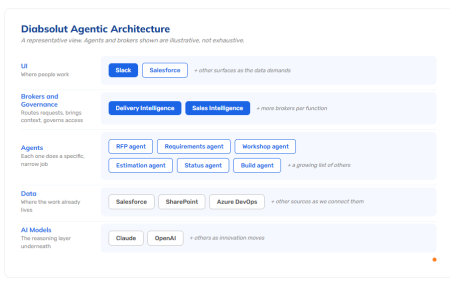
Five layers, read bottom up. What’s shown here is the shape of the architecture, not the full inventory. The real picture has more agents, more brokers, and more surfaces, and it’s growing.
At the bottom we run multiple AI models. Claude is our day-to-day reasoning partner. OpenAI is in the stack for tasks where its models fit the job better. We reserve the right to add others as they come up, and to pivot toward whichever lab is shipping the most useful innovation at any given moment. That flexibility is deliberate. The model layer is the one we expect to change the most over the next few years, and the architecture is built so that swap is cheap.
The data layer pulls from Salesforce (our delivery system of record, including Certinia), SharePoint (where most of our written knowledge lives), and Azure DevOps (where our engineering work happens). That mix is honest. Most professional services firms have their data scattered across three or four platforms that don’t talk to each other. We don’t pretend ours all lives in one place.
Above that sit the agents. RFP, Requirements, Workshop, Estimation, Status, Build, and a growing list of others. Each one does a specific, narrow job, scoped narrowly enough to actually be good at it. New agents get added to this layer regularly. That’s the whole point of the architecture: the cost of adding the next agent is low because the layers underneath already exist.
The brokers are the layer most other architectures don’t have. Delivery Intelligence and Sales Intelligence are two of our governed entry points, with more on the way as we build out coverage for each function in the company. A broker routes a request to the right agent and brings the right context with it. This is the MuleSoft Agent Fabric layer in practice. Without the brokers, you’ve got a pile of agents and a guess about which one to use. With the brokers, you’ve got an architecture.
On top, the UI. Today most of our agent traffic happens in Slack, because that’s where our people already work. But Slack isn’t the right surface for everything. Nobody wants to scroll through 400 requirements in a Slack thread, or review a thirty-row estimation breakdown on a phone. Some work needs a real screen and real structure, which is why agents also surface in Salesforce when the work is happening there, and we’ll add other surfaces over time as the data demands it. The architecture doesn’t care about the front door. The brokers and agents are the same regardless of where the user shows up.
Same pattern, every time. That’s how we get from new idea to new agent in a week.
Why I’m glad we picked this horse
I’m not going to pretend that being a Salesforce partner for over twenty years doesn’t shape this. It does. But that’s not really why I’m glad we picked this horse. I’m glad we picked it because the platform kept evolving toward the work that mattered, year after year, sometimes painfully, sometimes elegantly, but always forward.
I’ll say the uncomfortable part out loud. The name changes get exhausting. Pardot has been renamed. Einstein Analytics has been renamed twice. Data Cloud has had several names in five years. Things you built three years ago get end-of-lifed and replaced with something better named. If you’ve been in the Salesforce ecosystem for a decade, you know the fatigue. I feel it too.
But behind every one of those rebrands was real product evolution. The Salesforce we’re running our agentic enterprise on today is not the Salesforce I started on. It’s better. Materially better. The limits we worked around in 2011 are gone. The integrations that took six months are native. The reports that timed out are instant. The AI we used to hand-roll ships in the platform with governance attached. We didn’t pick a horse and hope it would still be relevant in 2026. We picked a horse that kept making itself relevant. That’s the part that earns the gratitude.
The agentic capability that ships with this stack today is, plainly, working for us. The Lobby, Concierge, Network architecture that makes our seven-day agent deployments possible only works because MAF exists. The collaboration model that makes our agents feel like teammates instead of tools only works because Slack is the surface. The governance story we tell customers, anchored today in AgentGuard and Data Cloud, is going to get stronger as we bring Informatica into our environment. We didn’t bolt this together from twelve vendors. We picked one platform that already saw the picture we were drawing, and we leaned in. We use the AI providers where they fit, on the personal productivity side, and we keep the production agents on the governed stack.
That’s the honest version of why we’re here. Not because the other options are wrong. Because this option fits us, today, the way we work, the customers we serve, and the bets we’re willing to make.
What I’m grateful for, and what we’re actually trying to do
When I started in this ecosystem fifteen years ago, I couldn’t have imagined the platform we’d be sitting on top of today. That doesn’t happen by accident. It happens because someone, year after year, keeps making the calls about what to build, what to buy, and how to wire it all together so it stops feeling like seventeen products and starts feeling like one platform. To everyone at Salesforce who has done that work over the past two decades, thank you. Diabsolut’s agentic enterprise wouldn’t exist without it.
To my colleagues, my customers, my Salesforce friends, the writers and analysts who have read these posts, and the partners across the ecosystem who have been generous with their time and their thinking: thank you. This series has been one of the best parts of a year that already felt special, and the conversations it has started have been better than the writing.
We’re not trying to change the world with this. We’re not trying to be revolutionary. We’re trying to be useful, and honest, and to bring a little calm and rationality to a conversation that’s had more than enough heat in it. The accidental agentic enterprise was always a small story. It’s about a small Canadian consultancy that asked good questions, picked a platform that kept earning the right to be picked, and tried not to confuse motion with progress along the way. If any of that is helpful to you, that’s all we wanted.
Thanks for reading. We’ll see you in the next conversation.
Read more in our Agentic Enterprise Series
- Part 1: Diabsolut: The Accidental Agentic Enterprise
- Part 2: Agents Don’t Run the Show — People Do
- Part 3: Zero to Live in a Week: What That Requires
- Part 4: Building on Salesforce’s Boring Foundation (We Mean That as a Compliment)
- Part 5: Why We Don’t Build Everything Ourselves
- Part 6: The Right Answer for Right Now
Diabsolut is a Salesforce consulting partner building the agentic enterprise in the open. Follow the series to see what’s working, what we’re learning, and what’s coming next.