
Diabsolut: The Accidental Agentic Enterprise
How solving one business problem built something much bigger — and why that matters for every Salesforce customer we serve.
Author: John Pettifor
The Origin Story

We didn’t set out to build an agentic enterprise. We set out to solve a business problem.
The context here is important. Diabsolut is a Salesforce consulting partner with over 20 years of expertise across Salesforce, Certinia, and MuleSoft. As experienced practitioners who understand the architecture, the edge cases, and the business problems underneath the technology — and like every other services firm out there — we were watching AI change the economics of what we do. Standard Salesforce configuration that used to take weeks was being commoditized. The question wasn’t whether AI would reshape consulting; it was whether we’d be the ones reshaping it or the ones getting reshaped.
So we asked ourselves a focused question: How do we deliver Salesforce professional services faster and better using AI?
That question led us to build an Architect Agent: an AI system that generates solution design documents, functional requirements, and technical specifications from structured input, using our own proprietary delivery knowledge and Salesforce documentation as its knowledge base. We targeted a 70% reduction in architecture document creation time. It worked.
But here’s what happened next: the Architect Agent needed structured input to be effective, which meant our presales scoping had to get more rigorous. Better scoping meant our sales team needed better discovery tools. Better delivery data meant our operations team could finally forecast with real numbers instead of spreadsheets. And every win we delivered faster became a case study that our marketing team could turn into pipeline.
The Accidental Part
 Instead of starting with a grand vision for an agentic enterprise, we built individual agents to solve real problems: faster solution design, better resource matching, more reliable project forecasting.
As those solutions started connecting, something unexpected took shape: an intelligent system spanning the entire services lifecycle. Sales improved discovery, presales generated more precise scope, delivery executed faster, and operations gained real predictive insight.
The architecture wasn’t designed: it was naturally discovered by bottom-up problem solving with enough architectural discipline to let the pieces connect.
What We’re Building
What’s emerging is something we now call our Enterprise AI Strategy: five synchronized intelligence domains designed to cover the entire services lifecycle. We’re building it in the open, and the first domain is already live and delivering results.
Delivery Intelligence™ is the flagship. This is live today and growing. Our Workshop Agent generates workshop agendas and materials from structured input, using our proprietary delivery knowledge as its foundation. It’s in production, on real projects, delivering real time savings. We’re adding roughly 5–10% capability every week, with the full Delivery Intelligence™ stack targeted for completion by summer 2026.
The remaining four domains have detailed charters, month-by-month roadmaps, and designated leadership. They’re beginning to come online in the coming weeks, with each release taking a meaningful leap in capability:
- Sales Intelligence
Agents like Deal Coach and a Salesforce-aware SlackBot help AEs analyze opportunities, guide discovery, and surface insights directly from live CRM data, turning Salesforce from a reporting tool into a real-time selling assistant. - Presales Intelligence
A Scope Architect Agent converts discovery into structured scope documents while an Estimation Engine compares proposed work against historical delivery data, producing calibrated estimates and confidence-scored pricing. - Operations Intelligence
Agents built on Certinia PSA match staffing to project needs, connect Salesforce pipeline to revenue forecasts, and predict capacity gaps before they affect delivery. - Marketing Intelligence
Delivery outcomes feed a content pipeline where agents generate case studies, thought leadership, and campaign insights tied directly to real project results and pipeline performance.
The Architecture That Supports It
These domains aren’t separate AI projects. They’re connected and structured:
- The shared foundation is a set of Model Context Protocol (MCP) servers
MCP connections expose our core business data (SharePoint for delivery knowledge, Salesforce CRM for pipeline, Certinia PSA for projects and financials, Azure DevOps for code and work items, Outlook for scheduling) to every agent across the ecosystem. Any agent in any domain can access the knowledge it needs without custom point-to-point integrations.
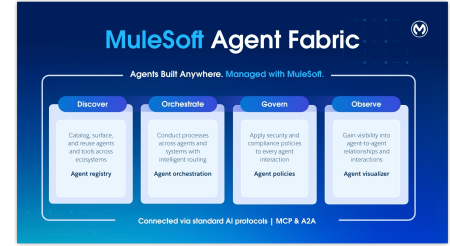 Orchestration runs through MuleSoft Agent Fabric
This central governance layer discovers, routes, and controls agent interactions. A Master Broker routes requests across domains. Team-level brokers handle domain-specific orchestration. Every agent interaction is logged, governed, and auditable.
- The AI generation layer combines multiple AI tooling
Agentforce for Salesforce-native agents, Data Cloud for unified customer data, and MuleSoft for integration and API orchestration, complemented by Claude AI for reasoning and generation, Microsoft Copilot for Teams and SharePoint integration, and Azure Functions for document generation and custom actions.
- The experience layer meets people on the channels they already use
Slack, Salesforce UI, email, and mobile: no one has to learn a new tool or switch contexts to access intelligence.
Salesforce Is The Natural Foundation
Agentforce alone isn’t Salesforce’s answer to AI. The real answer is Agentforce powered by the full stack described above, and critically supported by the incredible piece of structured CRUD software underneath it.
That last part doesn’t get enough credit. Salesforce at its core:
- Is a metadata-driven, permission-governed, audit-trailed platform
- Provides structured data models, role-based access, and enterprise-grade scalability baked in from the ground up
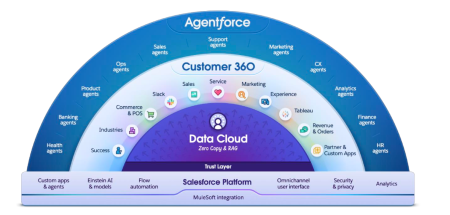 This solid foundation makes agentic AI safe and scalable. We can move at this pace and with this confidence because of how Salesforce is architected. We’re building intelligent agents on top of a platform that was designed for exactly this kind of governed, structured data access.
And we have no interest in recreating what these platforms already do well. The thought of someone vibe-coding their way to a financial management system that competes with Certinia gives us nightmares — and it should give every enterprise leader nightmares too. Certinia exists because financial management at scale requires years of domain expertise, regulatory compliance, auditability, and battle-tested logic. Slack exists because enterprise communication and workflow orchestration is a solved problem at extraordinary scale. MuleSoft exists because integration governance is genuinely hard. We don’t want to rebuild any of that. We want to make it intelligent. The right approach isn’t AI instead of these platforms — it’s AI on top of them.
This matters because most companies are using AI in profoundly inefficient and unsafe ways right now.
The Misconceptions Driving Bad AI Strategy
The typical approach is: give everyone a ChatGPT or Gemini license, hand them a few disconnected tools, and call it an AI strategy. We know where that leads because we’ve lived through the early lessons ourselves. Hallucinations and data leakage are real. The moment you point a general-purpose LLM at sensitive customer data without governance, you’re one bad prompt away from exposing information that should never have left your environment.
 But that doesn’t mean the answer is to lock AI down and wait for the enterprise-grade version to arrive. Pilots and experimentation matter enormously. Working with AI is fundamentally different from any tool most people have used before. The prompting, the iteration, the judgment about when to trust the output and when to question it — that’s a new muscle, and the only way to build it is to use it. Early AI experimentation builds the baseline literacy that makes the structured, governed, agent-driven approach possible — because when you roll out purpose-built agents, you need people who already understand what AI can and can’t do, who’ve felt the hallucinations firsthand, and who’ve developed the instinct to verify before they trust.
The risk is mistaking experimentation for strategy. The ChatGPT licenses, the disconnected tools, the “everyone figure it out” approach — that’s fine as a starting point. It’s dangerous as a destination.
Other common misconceptions might lead you in the wrong direction:
- Cost Reality: AI Pricing Is Unstable and Artificially Cheap
Most companies are building AI strategies on pricing that is heavily subsidized and unlikely to last. AI feels cheap today, but model providers are losing billions, meaning today’s $20/month licenses do not reflect the true long-term cost of operating these systems.
- Compute Waste: Most Organizations Are Using AI Inefficiently
Even when the outputs are good, the way companies use AI is extremely inefficient. Sending vague prompts or broad queries against large systems (like an entire Salesforce org) forces the model to process far more data than necessary. That increases token usage, compute cost, latency, and hallucination risk. Unstructured AI usage scales cost and errors rapidly — and the environmental toll compounds alongside it. Every unnecessary token processed draws on energy-intensive data center infrastructure. At enterprise scale, inefficient AI usage isn’t just a budget problem; it’s a carbon problem.
- Dependency Risk: Model Providers Will Change
The AI model landscape changes constantly. Organizations are already moving between GPT, Claude, Gemini, and others depending on capability and pricing. If your AI strategy is tied directly to a single model provider, your entire system becomes fragile. The model should be replaceable; the architecture should not be.
- The Missing Point: Architecture Matters More Than the Model
Winning with AI is about building the right architecture. What truly matters is the orchestration, governance, and structured data layer that make AI safe, efficient, and scalable. That’s the role Salesforce plays in your strategy.
This is the insight we keep coming back to: the companies that will win with agentic AI are the ones building intelligent agents on top of solid platforms, where the AI knows what it’s allowed to touch, what shape the data is in, and what the business rules are before it ever generates a response.
Salesforce gives us that. It’s why we’re building here.
What This Means for Our Customers
Now here’s the part that matters most: our business is implementing Salesforce.
We’ve become a living reference architecture for what the Salesforce platform can do when a company takes agentic AI seriously as a business operating model.
 And everything we’ve built to run our own company — the Delivery Intelligence™, the scoping precision, the operational forecasting, the AI-augmented project execution — is the same engine that delivers your Salesforce project.
- When we say “We can deploy a functional Salesforce foundation in 3–6 weeks instead of 6 months, and iterate from there”, it’s because our Architect Agent has already produced the solution design.
- When we say “Our estimates are calibrated”, it’s because our Estimation Engine benchmarks your scope against outcomes from hundreds of past projects.
- When we say “We’ll staff the right team”, it’s because our Staffing Agent aligns your requirements with the AI-augmented resources with the right skills, certifications, and availability in minutes.
We don’t sell hours anymore. We sell velocity of value — because our intelligence lets us stand behind the speed of delivery.
Where they implement Salesforce, we deliver outcomes powered by Salesforce.
The Bottom Line
By setting out to deliver Salesforce projects faster and better, Diabsolut became a live agentic enterprise, building something much larger than we planned.
Now we have five synchronized intelligence domains, 20+ purpose-built AI agents, a shared knowledge fabric, a Master Broker orchestration layer, and a 12-month roadmap that takes us from AI-augmented delivery to a fully outcome-based commercial model.
And because our business is implementing Salesforce, every customer benefits from the machine we’ve built. This is not an AI theory pitch anymore. We’re demonstrating what we live every day.
We built it by accident. We’re scaling it on purpose.
If you’re planning a Salesforce implementation — or simply exploring how to turn your platform into a more intelligent, AI-driven system — our Delivery Success team is always available for a conversation. We’re happy to review your current org, discuss opportunities for improvement, and help identify the best place to start.
Read more in our Agentic Enterprise Series
- Part 1: Diabsolut: The Accidental Agentic Enterprise
- Part 2: Agents Don’t Run the Show — People Do
- Part 3: Zero to Live in a Week: What That Requires
- Part 4: Building on Salesforce’s Boring Foundation (We Mean That as a Compliment)
- Part 5: Why We Don’t Build Everything Ourselves
- Part 6: The Right Answer for Right Now