
Ten Core Domains Decide Your Field Service AI Payoff
Authors: Naeem Khalid and Bryan Burns
 Field service runs into a constraint other AI discussions don’t carry: you can’t automate the person on the truck. The technician who shows up and turns the wrench is human, and that isn’t changing. So if the work stays human, where does Field Service AI actually pay off?
It pays off in more places than the usual answer suggests, and rarely where people look first. The reflex is to add some intelligence to scheduling and treat that as the whole job. That captures a sliver of the value. The rest sits in corners of the operation nobody thought to examine, and you only find it when you map the operation end to end.
The old field service maturity models had no agentic story
A maturity model is a structured read of how every part of a service operation runs today, and what better looks like at each step up.
Plenty of field service leaders have never worked with one. The ones who have are usually working from a model built for a different question: those models take you from spreadsheets to standardized process to workflow automation, and that climb still matters, but automation was available long before AI. What they can’t tell you is where an agent belongs or what one is worth. They were drawn before agents existed.
So we took that thinking, studied how the strongest operators run, and extended it through five levels for the agentic enterprise. Level 1 is reactive, where heroics and spreadsheets carry the work. Level 5 is autonomous, where agents run execution and people set strategy. Almost every organization we assess sits somewhere in between.
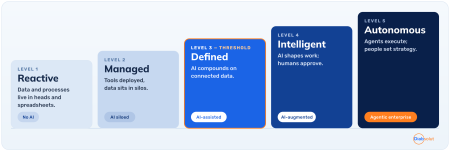
Run the assessment and most land at level 2 or level 3.
- At level 2, the foundations exist but stay locked in silos. AI shows up as isolated pilots.
- At level 3, the work is standardized and the data is connected, but nothing gets anticipated yet.
Level 3 is worth pausing on, because it’s the AI-readiness threshold: the point where AI starts to compound, because it finally has enough connected to learn from. Below it, there’s nothing solid underneath. Reach it, and the agentic roadmap turns from a slide into a plan you can sequence.
A single maturity score won’t tell you where to invest
The old models have a second weakness: the single number they produce. No real field service organization sits cleanly at one level. Run an honest assessment and you’ll find level 2 in one area and level 4 in another. That spread is normal, and it’s the most useful thing the assessment surfaces.
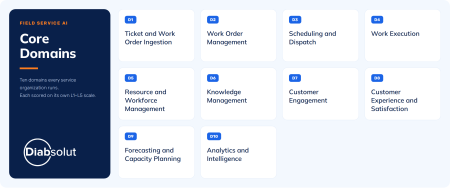
So we broke the service operation into domains and scored each one separately. Map enough operations and the same split turns up: some domains are in play at every service organization, whatever the industry, and some only matter depending on the kind of business you run. The model reflects that split.
The ten core field service maturity domains
The service operating spine, from the moment work enters the business to how intelligence flows back out. These apply to virtually every service organization, regardless of industry or asset intensity, so every operation can score itself against them.
The eight extended field service maturity domains
These are conditional rather than universal. Whether they apply depends on the type of business you run. But when they do apply, they’re often where the largest gains live. Asset-heavy, parts-heavy, and billing-led operations frequently find their biggest moves here, not in the core.
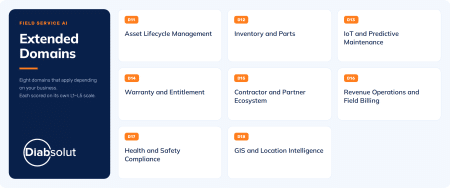
Each domain carries its own scale, the Agentforce capability that fits it, and the value waiting if you close the gap.
Scored this way, the model works as a roadmap. It shows where you stand across the domains that apply to you, where the business needs to be to stay competitive, and the order of changes that gets you there. Sequencing is the secret sauce that separates a program that keeps moving from one that quietly goes dark.
Field service AI saves money by cutting truck rolls
The value sits in the cost around the work. AI can’t do the physical job, so it earns its place by lowering everything else: the wasted trips, the standby crews, the admin. The number every field service leader watches is the truck roll. Sending a vehicle and a technician to a site is the expensive part of the business, and an emergency roll is the priciest version of it.
This is also where the extended domains earn their place in the model. Predictive asset maintenance goes straight at that cost, and it leans on another one, asset lifecycle management, to do it. Instead of waiting for an asset to fail and scrambling someone out the door, you flag the assets most likely to break and service them on a planned visit. Fewer breakdowns, fewer emergency rolls. It also shrinks a cost most people outside field service never see: the capacity buffer. Field operations staff for their worst day, carrying technicians who are only needed when several things fail at once. Make the work more predictable and that standby capacity comes down.
The same logic shows up at the technician level, in miniature, inside the core domains this time: work execution and knowledge management. Take the paperwork out of a job and a tech who used to fit three visits in a day can fit four. The agent does none of the physical work. It removes the admin around it, so the technician spends the day on jobs instead of forms. One environmental services company we work with runs a field tech agentic process for pre-work and post-work briefs, saving each technician hours of job-prep and job-closing admin. And the same point holds across every domain: keep people on the work where their judgment counts, and let agents take the rest.
Agentforce connects field service to the rest of the business
The typical field service solution is a point tool: it handles scheduling and dispatch, then stops at the edge of the function. Agentforce sits on the full Salesforce 360 platform, with sales, service, finance, and customer success on shared data underneath. The same agentic capability you apply to asset maintenance can run across all of them, so a demand forecast that positions technicians also informs hiring and budget, and a customer success signal can trigger a service visit before anything breaks. A standalone tool can’t see those connections. Build capability in one place and it compounds everywhere it connects.
Agent quality keeps improving after launch
An assumption worth retiring is that an agent’s value is fixed the day it goes live. It isn’t. The technology is maybe half the work. The rest is the steady discipline of watching how the agent performs with real users and improving it from there.
One example I come back to: we built a customer service agent for a large public-sector education provider that launched answering correctly less than a fifth of the time, around 18 percent. After the post-launch work our AgentGuard process is built for, accuracy reached roughly 80 percent in less than 3 months. Same agent, same underlying model, refined configuration. The gain came entirely from what happened after go-live.
The use cases I’d build next
A few sit at the top of my list for most field service organizations right now.
- A technician empowerment agent that briefs the tech before the job, answers technical questions in the field, and writes the wrap-up when the work is done. Knowledge capture is a key part of this one: the same agent that surfaces expertise on site is what turns each completed job, and each senior technician’s judgment, into knowledge the next tech can use. Work execution and knowledge management are core domains, and with hiring capped across the industry, more productive hours per technician is the fastest capacity you can add.
- A schedule and resource forecasting agent that reads future demand and suggests how to position people before the pressure arrives. Forecasting and capacity planning is a core domain, and one of the most commonly underdeveloped. It’s the planning-side answer to the same constraint: if you can’t hire your way out, positioning the workforce you have is the lever.
- A predictive asset maintenance agent looking at what maintenance work is out there and which components are most critical to service now to avoid future emergencies. This one is extended-domain territory, and for asset-intensive operations it’s frequently the largest prize on the board.
Each one aims at the same three targets: fewer truck rolls, more productive hours from the technicians you already have, and a smaller buffer of idle capacity.
You don’t need Level 5 everywhere
Maturity models may be new to you or old hat. Either way, the value here isn’t the framework itself, it’s the coverage. Every one of these domains can move the needle, and most organizations only ever look at two or three of them. Working from a map means you stop missing the others: the quiet ones like knowledge management or forecasting where nobody was looking, and the extended ones that may hold the biggest prize in your business.
It isn’t realistic to rush every domain to Level 5, we would never recommend that, and you don’t need to. What matters is knowing where the biggest impact sits for your business, and investing first where the payback is quick and noticeable. That takes a straight read of where you stand today, a realistic view of where the business has to be, and the right order to get there. Treat field service maturity as a map, and the places AI pays off stop being a guess.
Get your own read
If you’re curious where your own operation stands, our Next-Gen Service Assessment is a short, free way to find out. No pressure and no prep: we simply think you will find it insightful, a different way of looking at a business you already know well. Teams tell us it is surprisingly accurate, and the profile it produces makes a great conversation and alignment tool for you to take back to your leadership from day one. We hope it is helpful.
—
Book a meeting with one of our Field Service experts to discuss your platform evolution.