
Your field service AI program is live. So why doesn’t it feel like winning?
By now, a funded and deployed field service AI program is standard. The strategic results leaders expected from it haven’t followed. The reason is the operating model that surrounds the technology.
Author: Bryan Burns
If you run a field service operation, there’s a good chance your AI story sounds like this: a formal program, executive sign-off, real budget, deployed tools. On paper, you’ve adopted. You’re not behind. You’re right in the middle of the pack.
That’s the problem.
The State of Field Service in 2026, a survey of one hundred senior service leaders by Field Service Next Insights, found that 68% of organizations have taken a formal approach to AI adoption that is “growing in its impact.” Only 15% report extensive, strategic adoption across their field service organization. And just 11% say they see rapid returns on their technology investments.
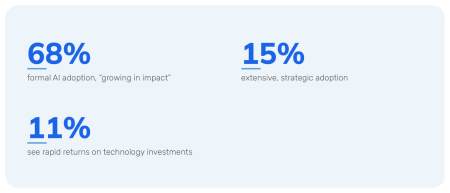
Put those three numbers next to each other and the shape of the problem changes. Adoption isn’t the issue: 83% of organizations are already past the pilot stage. The field service sector has a plateau problem that comes after the pilot. “Formal and growing” describes an operation that has deployed enough to report progress without embedding enough to move the numbers.
If your instinct is that the gap comes down to better models or the next feature release, the evidence points elsewhere. The organizations stuck on the plateau and the ones pulling away are, for the most part, buying the same technology. The difference is in everything around it.
Four reasons you’re stuck, and none of them are the software
1. The process was never redesigned
AI was laid on top of workflows that were never rethought. Scheduling policies copied from the old system. Skill matrices nobody has audited in years. Territories drawn around history instead of demand. Optimization can only optimize the process it’s given. When that process was never deliberately redesigned for the new technology, AI just produces the same outcomes faster. The survey backs this up: inadequate adoption processes and rollout planning is one of the top three barriers to realizing value from technology investments, cited by 40% of leaders.
2. Your systems integrator did what you asked, not what you needed
This one is uncomfortable for us to write, because it’s our industry. The typical field service implementation is delivered exactly to the requirements the customer wrote. That’s the failure. The requirements described the operation as it was, not as it needed to become. A partner who implements your as-is process with new technology has automated your constraints. You needed a partner willing to challenge the order, not just fill it, and one with the experience and standing to do it.
3. Service is still positioned as a cost center
Only 17% of service organizations operate as a profit center with real P&L accountability. The other 83% are asked to justify operating-model investment from inside a cost line, which is nearly impossible. A cost center gets funded to cut costs, so AI gets scoped as a cost-cutting tool, deployed narrowly, and measured on savings it was never positioned to maximize. The organizations in the 15% treat service as a business. Their AI investment is measured on growth, retention, and capacity: numbers that justify the next phase.
4. Your dispatchers and technicians are working around the system
The quiet killer. Adoption dashboards look fine while the real operation lives in phone calls, text threads, and spreadsheets. Dispatchers override the optimizer because they don’t trust it; technicians close work orders from the parking lot at 6 p.m. with whatever gets the screen to go away. The system records a fiction, the AI learns from the fiction, and leadership makes decisions on data the field stopped believing in months ago. No model, however good, survives an operation that has quietly voted against it.
The pattern: it stems from the operating model
Look at the four causes again**: a process nobody redesigned, a partner who didn’t push back, a funding model that can’t invest, a field that routed around the tools. None of them is a technology problem. They’re all operating-model problems, which is why more technology keeps not fixing it.**
The industry’s own research keeps arriving at the same conclusion. The Field Service Next report notes that technology “falls short when organizations underestimate the effort required to train people, redesign workflows, and secure sustained leadership support.” TSIA’s research on the AI services era makes the same argument from the economics side: as AI capability commoditizes, the value shifts to the last mile of readiness, governance, optimization, and outcome ownership. The winners changed how they operate; the algorithm was never the variable.

The operating model of the future is definable and measurable
The destination, at least, isn’t a mystery. The agentic field service operation is specific enough to define, stage by stage: scheduling runs autonomously with humans on exceptions, technicians arrive briefed and leave with documentation already done, and the system learns from real signals because the field uses it instead of working around it.
That’s what our Service Maturity Model does. It defines the operating model of the future and the stages between here and there: from reactive, through optimized and connected, to agentic. Each stage names the process, data, funding, and adoption conditions that have to be true before the next stage pays off. It’s how you distinguish “we deployed the feature” from “the operation actually changed.” That is the exact line the 68% haven’t crossed.
Used honestly, it also does something most technology roadmaps won’t: it tells you what not to buy yet. If your scheduling policies were never redesigned, autonomous scheduling will disappoint you; sequence that work first. If the field already works around the system, agent-generated briefs will be ignored like everything else, so fix trust in the tools before you ship them. Sequencing is the difference between an investment that compounds and another line item on the plateau.
Always start from the outcome
And every stage starts in the same place: a defined business outcome**, stated in the operation’s own terms. “Cut same-day dispatch cost by a third.” “Raise first-time fix by five points.” Those are outcomes. “Deploy autonomous scheduling” and “roll out mobile AI” are deployments, and the plateau is full of deployments.** The 15% define the outcome before they pick the technology, instrument it so it can be measured, and hold every phase of the investment against it. Programs stall on vague ambitions and move on measured ones.
It also changes what you should demand from a partner. If the outcome is defined and measurable, there’s no reason your partner shouldn’t put skin in the game against it. That’s the standard we hold ourselves to: every engagement starts from the outcome we’re being measured on, and we take accountability for hitting it. A partner who won’t tie themselves to your outcome is telling you how confident they really are in the plan.
Find out where you currently stand
Every organization we’ve run the model against thought they were further along than they were. That’s not a knock on them; it’s the predictable result of measuring adoption instead of operations. The dashboards say “formal and growing.” The outcomes say plateau.
The Field Service Maturity Diagnostic
A short, structured engagement that plots your operation on the maturity curve across process, data, funding model, and field adoption, rather than deployed features alone. It gives you an honest read on where you are, why earlier investments underperformed, and a sequenced path to the operating model the 15% are already running.
We run the diagnosis and hand you a sequence you can act on. Talk to us about putting it against your operation.
Sources: The State of Field Service in 2026, Field Service Next Insights (survey of 100 senior service leaders); TSIA, “The AI Services Era: Why Services Are Now Your Greatest Advantage” (J.B. Wood, October 2025).