
Agentic AI Explained: What It Is and Why It’s Transforming Intelligent Workflows
Author: Vivek Rathod
If you’ve been hearing the term Agentic AI and wondering what all the excitement is about, you’re not alone. This innovative approach to artificial intelligence is rapidly gaining traction because it can handle much more than simply answering questions or predicting outcomes. Agentic AI is designed to think through complex problems, take action autonomously, and continually learn. This makes it a powerful partner for tackling the challenges of modern business. Let’s explore what makes it unique, how it works, and where you might see it in action.
What Is Agentic AI?
In simple terms, Agentic AI is an advanced type of artificial intelligence that can reason through complex situations, decide what to do, and carry out tasks on its own without needing constant human instructions.
You can think of it as a smart digital colleague that observes what’s happening, determines the best steps, acts on those steps, and then learns from the results—improving over time.
Agentic AI:
- Goes beyond simple question-answering to handle more complex, multi-step tasks
- Pulls in data from a variety of sources to understand what is going on
- Develops strategies and follows through without needing you to micromanage
- Continuously improves by learning from feedback
The Iterative Process of Agentic AI
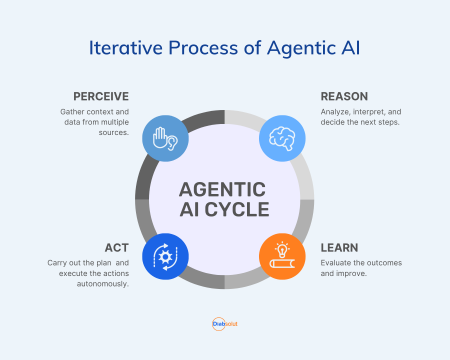
Agentic AI does not just make a single prediction and stop. Instead, it follows an ongoing cycle much like human problem-solving:
Perceive – Gather information from all relevant sources.
Reason – Analyze what that information means and decide the next step.
Act – Execute the plan or complete the task.
Learn – Evaluate the outcome and adjust the approach.
This continuous loop means Agentic AI consistently becomes sharper and more capable.
Understanding the Differences: AI Agents, Features, and Functionalities
It’s easy to get confused by AI terminology. Here’s a straightforward way to keep it clear:
The AI Agent is the system that takes on a goal and drives it forward independently. Think of it as a digital teammate who brings specialized skills to the table, set out to accomplish a clear objective, like resolving a customer issue or coaching a sales rep.
To do this, the agent relies on features—its core capabilities, like natural language understanding, data analysis, and pattern recognition. It applies those features to gather and interpret information, plan actions, and make decisions. For example, it might read a customer email using natural language processing, pull account data through search, and analyze sentiment.
What really matters is how these features are combined. This combination forms the foundation of what the agent is designed to achieve. For instance, an onboarding agent combines language processing, document automation, and workflow features to guide new hires through each step seamlessly.
When these features work together, the agent delivers functionalities—the specific tasks that achieve its purpose and carry out the work, such as generating a response, updating records, or scheduling follow-ups.
In other words:
- The agent is the orchestrator that brings everything together to pursue a goal.
- The features are the abilities it combines and configures to form its core capabilities.
- The functionalities are the real-world tasks it performs to deliver value.
This is what sets Agentic AI apart from traditional AI tools. It blends multiple skills into an intelligent system capable of completing meaningful work from end to end.
How Agentic AI Differs From Other AI Approaches
You might wonder why all AI isn’t equally autonomous and adaptable. The reality is, most AI systems are built to do one thing very well, such as predicting maintenance needs or answering questions in a chat.
Agentic AI goes further by managing entire processes independently. Here’s how it stands out:
- It operates with greater autonomy, without waiting for instructions.
- It uses deeper reasoning beyond basic predictions.
- It adapts to evolving circumstances rather than remaining static.
- It coordinates multiple actions to accomplish broad goals.
Why Agentic AI Is Gaining Momentum
Businesses today are dealing with more complexity than ever. Customers expect fast, personalized experiences. Operations stretch across multiple regions. Data streams in from dozens of systems.
Agentic AI can help organizations:
- Solve real-world problems that are too dynamic for rule-based solutions.
- Free up teams to focus on more strategic work.
- Speed up decisions with continuous learning.
- Create new opportunities for innovation.
Real-World Use Cases of Agentic AI
To paint a clearer picture, here are a few examples of where Agentic AI can step in:
Customer Service Rep Agent
An AI agent that does more than respond to questions. It pulls up customer histories, suggests solutions, escalates when needed, and follows up automatically.
Discover our Customer Service Agents Suite here.
Field Technician Assistant Agent
A field service agent can guide technicians through repairs, order parts, and update work orders in real time.
Discover our Field Service Agents Suite here.
Sales Coach Agent
A sales-focused agent can monitor pipelines, recommend next steps, and even draft tailored follow-up emails.
Employee Onboarding Agent
An onboarding agent can walk new hires through processes, answer their questions, and make sure all forms and tasks are completed without constant manual check-ins.
Looking Ahead: The Future of Agentic AI
Agentic AI isn’t just a passing trend. It marks a shift toward systems that are more adaptable, resilient, and intelligent.
Organizations that start exploring these solutions today will be better prepared to move faster, deliver better experiences, and stay ahead as AI evolves.
Ready to see Agentic AI in action?
With our Agentforce Quickstart Offer, you can get a fully functioning agent up and running in less than 6 weeks on your Salesforce platform. Choose from proven solutions like a customer service rep agent, a field tech assistant, a sales coach, or an onboarding agent. You only pay if you are completely satisfied with the results.
Explore which agent could make the biggest impact for your team.