
What the 2026 SPI Benchmark Is Telling Us
For International Services Week – Services by the Numbers
Author: Uriah Hakala
 I read the SPI Research Professional Services Maturity Benchmark every year. It’s one of the few industry reports I actually trust: 509 firms surveyed this year, 245,000 employees, $63 billion in PS revenue. When SPI talks, I pay attention.
The 2026 edition dropped in February. The theme for this year’s International Services Week is “Services by the Numbers,” so it felt like a good time to share what stood out, and what it’s made us think harder about in how we run our own business.
The Headline: Things Got Better. Kind Of.
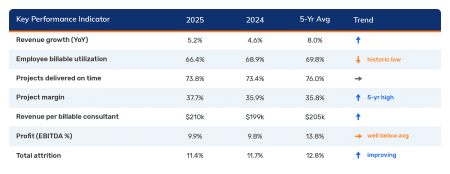
Revenue growth ticked up to 5.2% in 2025, from 4.6% the year before. Project margins hit a five-year high at 37.7%. Attrition came down. On balance, the market moved in the right direction.
But I’d push back on anyone calling this a recovery. The historical average revenue growth rate for professional services is closer to 8-10%. We’re at 5.2%. And in the one area I think matters most, things got worse.
Billable utilization dropped to 66.4% in 2025. That’s the lowest number in the benchmark’s 19-year history. The target threshold is 75%. We were already below it last year. We went further in the wrong direction.
That one number probably explains more about why EBITDA is sitting at 9.9%, well under SPI’s expected 15%, than anything else in the report.
AI Can’t Fix What You Can’t See
Almost every conversation I’m having with services leaders right now has AI somewhere in it. And I get it. The benchmark backs it up. Between 26% and 38% of projects now include AI components. Forty percent of firms are actively selling AI services. The market has moved past “are we doing this” to “how fast.”
But I keep seeing the same thing: firms are reaching for AI to solve a delivery problem that’s actually a visibility problem. Utilization is down because leaders can’t see demand clearly enough to staff against it. Projects miss on margin because nobody’s catching the drift until it shows up in the finance report. The data is there. It’s just not connected, not surfaced, not actionable in time to do anything about it.
SPI tracks executive real-time visibility scores, and they dropped again this year, from 3.65 to 3.53 on a five-point scale. The leaders running the most complex service businesses are becoming less confident in what they can see, not more. Layering AI on top of that doesn’t fix the foundation.
The firms that reversed the utilization trend didn’t do it by adding more tools. They did it by connecting the ones they had.
What We Changed, and Why
This is where I’ll be direct about what we’ve done at Diabsolut, because I think it’s relevant.
We’ve invested heavily in what we call Delivery Intelligence™, our methodology for turning delivery data into real-time operational insight. The honest reason we built it is the same reason utilization keeps declining across the market: without it, too much of a consultant’s time goes toward tracking down status, chasing updates, and managing the mechanics of delivery instead of delivering.
What it’s allowed us to do is shift our team’s focus away from those mundane tasks and toward the things that matter to clients: outcomes and adoption. When the operational picture is visible and current, our consultants spend their time on change management, on making sure the solution lands, and on the conversations that determine whether a client realizes value or just goes live. That’s a different kind of engagement, and it’s why we restructured our consulting roles this year around outcomes, not just deliverables.
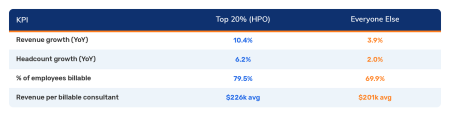
The benchmark data on HPOs points to the same pattern. The top 20% of firms kept 79.5% of their workforce billable versus 69.9% for everyone else, but more importantly, they grew revenue at nearly three times the rate. That’s not just a utilization story. That’s what happens when your people are working on the right things.
The People Side of AI Adoption: AI Works When the Organization is Ready
Back to AI for a second, because I don’t want to be dismissive of it. The returns are real for firms that approach it as an organizational capability rather than a product rollout.
SPI found that the biggest barrier to AI adoption isn’t the technology. It’s workforce readiness. Time-to-ROI on AI investments has nearly doubled in some cases, largely because successful adoption requires data quality, governance, and genuine enablement, not just access. The HPOs in the benchmark that are winning on AI reported year-over-year proficiency gains approaching 33% among their consulting teams. That kind of improvement doesn’t happen by accident.
What we’re seeing with our own clients mirrors this exactly. The implementations that go well are the ones where the organization shows up ready to change how it operates. The ones that struggle are usually trying to use new technology to avoid making that change.
The Number I Keep Coming Back To
66.4% utilization. Historic low. Four straight years of decline.
If your number looks like that or worse, if you’re not sure what your number looks like, that’s the conversation worth having. Not about AI, not about new tools. About whether the data you need to run your business is visible to the people who need to act on it.
The rest of the metrics in this year’s benchmark give me real optimism. Margins are up. Revenue per consultant is moving in the right direction. Attrition is improving. But utilization and EBITDA are the report card for how efficiently a services business runs, and until those move, the rest of it is incomplete.
Worth reading the full SPI report if you haven’t. There’s a lot more in it than I’ve covered here.
Source: SPI Research, 2026 Professional Services Maturity™ Benchmark (19th Annual Edition, February 2026). Survey of 509 firms representing 245,000+ employees and $63 billion in PS revenue.