
______

Powered by Delivery Intelligence™
Delivery Intelligence™ (DI) is our human-led, AI-accelerated approach to Salesforce transformation. People make the calls. AI carries the load on the parts that used to slow delivery down.
It’s how we move faster without trading away control, and it’s the engine underneath all eight steps below.
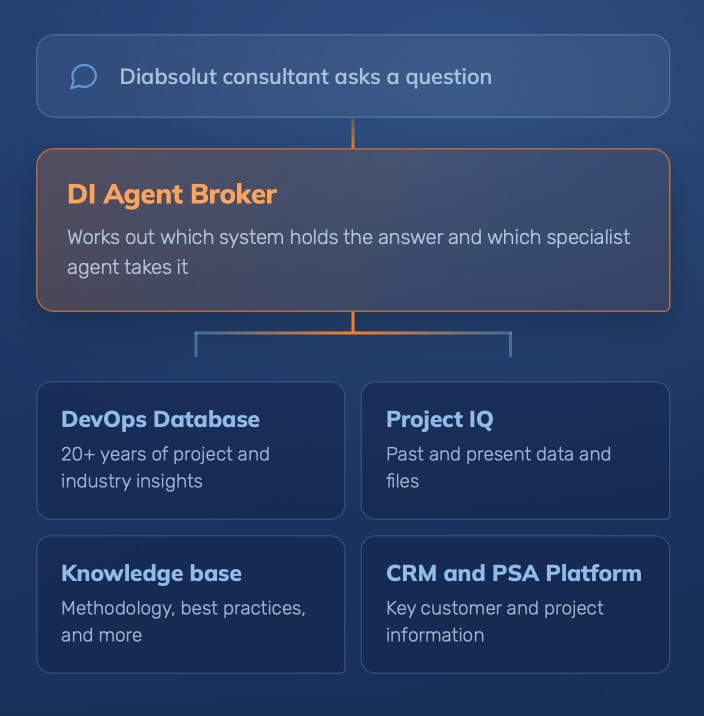
Underneath one interface, Delivery Intelligence acts as a broker. A consultant asks a delivery question or requests a delivery action; DI works out which system holds the answer, what project context is needed, which specialist agent should take it, and when several of them need to run in sequence.
It reaches straight into the systems the work actually lives in: Azure DevOps, Project IQ, our internal knowledge base, Certinia PSA. Which means the hours that used to go into hunting for the right SOW, reconciling three versions of a requirement, or rebuilding context after a staffing change go into the design decisions instead.
Your program is governed the same way we govern ours.
ANCHORED IN WHERE YOU STAND
We score each capability area and sequence changes accordingly
Readiness is never uniform. Service might have clean data and no governance, finance the reverse, and field operations may be relying on integrations no one has touched in years.
We rate each capability area on what agents depend on: data, process definition, real-time access to systems, and whether governance exists in practice or only on paper. Each score lands on a pre-defined capability maturity level. This tells where you are, while your aspirations say where you want to go. The biggest gap in the most important process tells you what needs attention first.
Curious to know where you stand?
PROVEN BEFORE IT SCALES
The first build is deliberately small
We typically start with one process, one team, one agent. If the number moves, you scale it. If it doesn’t, you’re only a couple weeks away from fine-tuning it and prove its value. The second use case is now faster than the first because the connections and the governance are already in place. And everything after that gets built on what the first one taught us about your systems, your data and your people.

GROUNDED IN A DEFINED PLAN
We map before we build
In every estate, we inventory the capabilities that exist but were never switched on, the data already available, the processes in place, and the best opportunities to cut manual and redundant work. Governance gets written once at the top and inherited all the way down, like traffic laws that apply on every road your agents circulate on.
The Enterprise Charter
becomes your roadmap
Sets the order of investment across functions and shows how each domain supports the others, so they reinforce each other instead of duplicating work.
Owned by the CEO or COO
The Domain Charter
is your city plan
Catalogues what the function has and what it lacks, so you can tell where an agent is the right answer and where the fix is a tool, an automation, or training.
Owned by the function’s executive
The Agent Charter
as the vehicle blueprint
Documents what the agent accomplishes, where the human gates sit, what it deliberately doesn’t do, and everything it needs to work as intended.
Owned by the team it works for
BUILT AROUND YOUR PEOPLE
We run change management alongside the build
We monitor and support adoption from the first workshop through every quarterly review rather than saving it for launch week. Training plans, documented best practices and human review points get built into the solution itself, and we stay with your team through the change.
Your team works alongside the agent before it touches the full queue, which is where most of the objections surface and get resolved. Enablement keeps going after the launch.
Adoption is the number one success factor.
SEEN BEFORE IT’S SIGNED
You get a working prototype before the project is signed and launched
With Forward Deployed Prototyping (FDP), we build a working Salesforce prototype around your industry, your terminology and the outcomes you’ve named, usually within 24 to 48 hours of a first conversation. Your team shapes it live during the demo, and it feeds straight into the steps below.
8 steps to reach your outcomes
1. Inventory
what you own and do
We go function by function and record the systems that actually run the work, plus the AI capability already sitting inside them, marked active, dormant, or one entitlement away. Everything after this depends on that picture being accurate.
Result: A systems and embedded AI inventory, plus an activation list ranked by effort
Timeframe: 1 to 2 weeks per function, 3 to 5 if we sweep several at once.
What’s your role: Point us at whoever owns licences and entitlements, and put one operational lead per function in the room who knows how the work really runs.
That is the normal starting position, and a large part of why the step exists. Together, we map systems, licences and entitlements, function by function, including the AI capability already sitting inside them. Also the processes as they actually run, the tools teams bought on their own, and the methodologies shared across departments. Many organizations find at least one AI capability they are paying for and not using.
With support from our internal Workshop Planning and Requirements Agents, discovery prep drops from most of a day to under an hour, drawn from insight across 300+ past similar sessions. Those hours go back to your project, spent deciding which outcomes are worth chasing to achieve significant measurable impact on your operations.
2. Identify
the processes worth targeting
We examine the processes together and rank them against the outcomes the business is measured on, with a current baseline. Ranking by dependencies as well as payoffs keeps focus on the changes that will truly serve your business.
Result: A ranked shortlist of candidate agents, each tied to a number and a baseline
Timeframe: 1 to 3 weeks, faster if your operational reporting is already trusted.
What’s your role: You own the ranking. You confirm which outcomes count, and you bring in the experts who know exactly where the process hurts.
No. We suggest you pick one to start, and the rest stay in the charter with a sequence and a dependency note. Nothing found here gets lost, and the second agent moves faster because the first one cleared the path.
Our delivery architects work as outcomes consultants, trained to challenge the process rather than document it as found. You spend the budget automating the workflow worth having, not making an inefficient one run faster.
3. Define
the charters
A domain charter per function sets what to keep, what to switch on, what to build and in what order, and the enterprise charter above it becomes the roadmap that carries governance down to every function. Fixing the plan first means the foundations you strengthen next are the ones it actually depends on.
Result: A domain charter per function, and an enterprise charter that reads as a roadmap
Timeframe: A few days per charter, dependent on the complexity of the business processes
What’s your role: The function leads own their domain charter, and your senior executives settle the order the functions move in.
You can, and plenty of clients do when they’ve already identified their best first use case. We compress the first two steps into a fixed-scope working session series and hand over the relevant charters at the end.
Diabsolut’s charter models stay in use long after the plan is signed. Every design and build decision gets checked back against them, so people, data, limits, dependencies and integrations stay accounted for as the project moves. The plan holds when sponsors change, and it stays yours whether or not we build any of it.
4. Solidify
your connections and data foundations
The charter names the agents, which tells us exactly which data and connections have to hold: current records rather than overnight exports, identity that survives across systems, APIs quick enough for a live conversation. We clear what blocks the first agent and schedule the rest.
Result: A scored data and integration readiness map, with the blocking gaps closed
Timeframe: 2 to 8 weeks, at the top of that range if your platform maturity level requires significant updates
What’s your role: Provide us access to your systems.
The data your first agent reads has to be reachable and reliable. How reliable depends on what it does: a drafting agent can work around a gap, one that quotes prices cannot. Everything else can come after.
A running agent is also one of the better ways to clean the rest. It surfaces the duplicates, gaps and stale records that only show themselves when something tries to use the data, so hygiene improves over the agent’s first few weeks live.
Real delivery starts here, so our Certinia Staffing and Project Assistant put the specialist you need on the task that needs them. Sharper forecasting on our side, tighter cost control on yours.
5. Design and build
your agents and control plane
The business intent set out in the charter becomes a workable plan: the components the agent needs, the systems it reaches into, its decision points, its escalation paths and the handover to a person. We build against that document, so what ships matches what the function signed.
Result: A build-ready agent design, and the agent built against it
Timeframe: 1 to 2 weeks per agent, quicker once the first one in a domain is done.
What’s your role: Validate the plan. Your functional SMEs confirm it delivers what the charter asked for, and you nominate the risk reviewer for anything customer-facing or regulated.
Less than you will want by month three. Start at draft-and-approve and widen the mandate once the ledger shows the agent has earned the trust. Every client pushes back on this and roughly none regret it afterward.
Our Solution and Build Agents draft the design and first build from your own org metadata and two decades of delivery patterns, then a Diabsolut architect edits and owns it. You get the pace of generated work with the accountability of a named engineer.
6. Test and deploy
into real operations
The agent ships on the platform you already license, inside your governance, into live operations. Defined first population, rollback path, measurement wiring switched on before it takes its first case. It works a real queue from day one. From here on, everything you learn about the agent comes from real traffic.
Result: A live agent in production, working a real queue
Timeframe: 3 to 8 weeks for the first agent, longer if production approvals are heavy.
What’s your role: Announce it and staff it. You handle internal comms to the affected team and name whoever signs off production changes.
Expect it at first. The launch version of an agent rarely hits its number, which is why we launch early and tune on live traffic instead of guessing in a sandbox. Most of the gap closes in the first few weeks, on real cases rather than test ones.
We now put only 40% of our effort before deployment, which gets you live sooner and returning value earlier. The rest goes into staying involved afterward, where real-world iteration keeps growing what the agent delivers.
7. Fine-tune
your agents to optimize their impact
We read the ledger against baseline on the numbers the charter committed to, then tune the agent on real traffic: escalations it should have handled, data it should have access to, phrasing that confused it. By our estimate around 60% of the work sits on this side of go-live.
Result: An agent continuously monitored over several weeks, and tuned on real traffic
Timeframe: First reads are weekly, then monthly, with most tuning inside 90 days.
What’s your role: Hold the review. Attend the regular performance reviews, and each agent has a named owner responsible for its number.
Whatever the agent charter committed to, read against the baseline from step 2. Handle time, first-contact resolution, cost per case, cycle time, forecast accuracy.
We do the tuning at first, with your supervisors telling us what the agent got wrong. Some of the work is adjusting topics and instructions rather than engineering, so your team stays involved as much or as little as needed.
AgentGuard™ covers the period after go-live. Our team looks at what your agents are doing and why; they read those signals, catch drift and rising cost while they are small, and tune the prompts, topics and actions behind them. You get the fixes and a report on what changed and what we recommend next.
8. Scale
your agentic footprint
The proven agent expands to the next team and the next charter item starts, with the earlier steps shrinking because the inventory, the readiness map and the connections already exist. New agents inherit governance and best practices.
Result: An agentic operating model, and a roadmap that reflects your industry and business priorities
Faster than the first, and faster again after that. The inventory, the readiness map and the connections already exist, so a second agent in the same domain is usually a matter of weeks.
Two decades of delivery experience in field service, high tech, professional services and consumer services shapes the sequence, so your long-term plan reflects what held up at scale based on segment-specific observations and insights from past customers and market context.
Show us your systems, we'll show you the routes.
We’ll map what you already run, and find the processes where agents fit best first.