
An AI licence buys you an engine. An agentic enterprise is everything that makes it drive.
AI MODELS
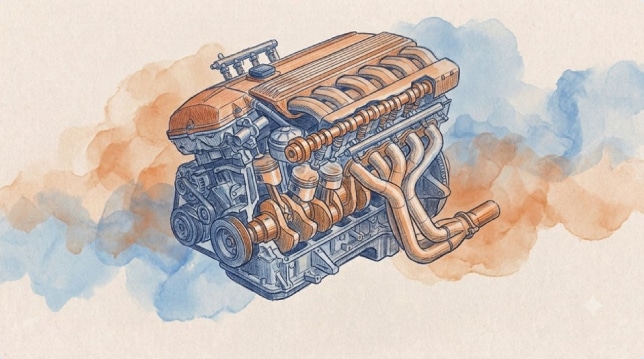
Think of an LLM as an engine
An AI model (a Large Language Model, or LLM) is the technology behind today’s AI tools. It is a system trained to understand language and generate useful responses. Give it a prompt and it produces an answer: it drafts, summarizes, explains, reasons and writes code, often at a level that feels like magic.
Like engines, models are complicated pieces of machinery that experts know at a deep level. What you need to know is simpler than that.
A model is trained on a huge amount of text until it gets good at one thing: predicting what comes next. When you prompt it, it generates the answer piece by piece, each word chosen from everything it learned. It is not looking facts up in a database, it is predicting the most useful response, which is what makes it so fast and so fluent.
– Claude’s Opus is known for careful writing, reasoning and coding.
– GPT is a versatile all-rounder with a broad tool ecosystem.
– Open models can run on your own hardware.
And some are purpose-built: specialized models tuned for a single domain or task like medicine, law or code, the way a diesel engine is built to tow and a race engine is built for the track. You match the model to the job, and you can swap in a better one as they improve.
A few manufacturers are competing right now to prove theirs is the right one for you. That is good news, because it gives you choice, and the innovation is happening as we speak.
Like engines, models come in different sizes for different trips. Sometimes you want a Vespa: quick, cheap and perfect for scooting across town, the equivalent of a small job like updating a field or writing a summary. Sometimes you need a V8 in a truck to haul a heavy load, a bigger model that can reason across dozens of systems at once. Part of the skill is picking the right engine for the trip.
Any engine, however powerful, has the same limit: on its own it goes nowhere. Put it on a stand and it revs all day, giving you noise and heat but no movement. A disconnected model licence is the same. It has no goal it is driving toward, no memory of what it did before, and no hands to touch your systems. It waits for a person to feed it a prompt, then waits again while that person carries the answer wherever it needs to go. Real value, still stuck in place.
AI AGENTS
An agent is the car built around it
The AI agent is the body that gives the engine a destination and somewhere to drive.
Every major platform is now building its own car. Agentforce drives the Salesforce world, Copilot drives Microsoft data, Bedrock AgentCore drives the AWS estate. Each one knows how to get around one town.
The car gives the engine two things it never had. A destination: you hand it an outcome to reach rather than an instruction to run, and it breaks that outcome into steps and re-plans when things change. A map of your town: it knows where it can go and what it can do inside your business.
A model answers. An agent acts. And you stay in the driver’s seat: you set the destination, you can take the wheel at any time, and it stays inside the lines you draw.
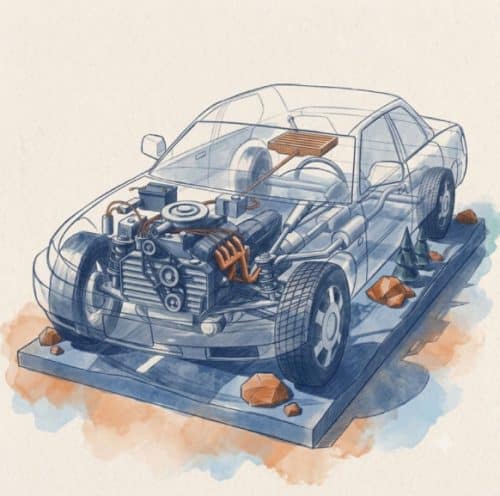
CAR BLUEPRINT
Agent charter
The plan the agent is built from. It sets what the agent is for, what it can do and how it behaves, so every part below follows one design.
ENGINE
Model (LLM)
The power that produces the work. On its own it only generates; the rest of the car turns that output into defined action.
FUEL
Data
The agent runs on your data, and its quality sets how far it gets. Better data, better output and further reach on every run.
STEERING WHEEL
Human in the loop
You stay in control the whole way. You set the destination, you can take the wheel any time, and the agent hands back to you when it should.
CRUISE CONTROL
Autonomy dial
You set how much the agent handles alone and where it checks with you first. Full speed on routine work, a pause on the sensitive steps.
LANE LINES AND GUARDRAILS
Policy limits
The lines the agent cannot cross, set in advance: which actions it takes and which data it touches. It stays in bounds by design.
DASHBOARD
Monitoring and control plane
One live view of what the agent is doing, what it has touched and how it is performing, so you steer the work in real time.
CHECK ENGINE
Alerts
The agent flags a problem the moment it happens, so you catch the one that needs attention before it stalls, or before a customer does.
SEATBELTS AND BRAKES
Fail-safes
When something goes wrong the agent protects the work in progress and stops cleanly, instead of pushing ahead and making it worse.
ODOMETER AND GPS HISTORY
Visibility and action logging
A full record of everywhere the agent went and every action it took, so you can audit any run and prove what happened after the fact.
AERODYNAMIC DESIGN
Efficiency and iteration
Refined over many runs to do the same work faster and at lower cost, so it gets cheaper to operate the more you tune it.
At this point the agent drives its own town beautifully. Reaching the next town, your ERP, your files, the open web, is where the highways come in.
THE CONTROL PLANE
Your governance platform is your connected road network
A handful of agents is not an enterprise. It is a few cars with nothing between them.
To make agents run as one system you need a single layer underneath them, something that:
– catalogues every agent you have
– coordinates who does what
– governs the rules and limits for each
– watches what they are doing
– lays the connections between your systems
Build that network once and everything above runs on top of it. It is what lets a car leave one town, reach another, and finish the job.
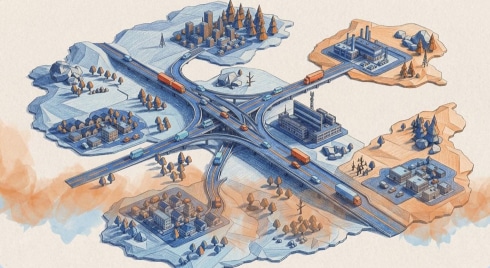
CARS ON THE ROAD
Your AI agents
The fleet itself. Different agents run different routes for different jobs, moving in step with the traffic rules and aware of each other, and any one of them can raise a check-engine flag the moment it needs attention.
HIGHWAYS
MCP and API connections
How agents get onto the network and reach your data hubs. These connections link agents to your live systems, so they pull from and act on real data rather than a copy of it.
TOWNS
Data hubs
Where the fleet fuels up and delivers. Your systems of record, the CRM, the ERP, the data lake, are the hubs agents pull from and drop results into, so every agent works from one source of truth.
DISPATCH CENTRE
Orchestration layer
Coordinates the whole fleet. It routes work from one agent to the next, sees every agent at once, and can start, stop or reroute any of them, so many agents run as one system without colliding.
TRAFFIC RULES AND LIGHTS
Governance
The rules of the road every agent follows. Governance is how you monitor whether agents stay compliant, step in to course-correct when they do not, and update the policies as conditions change.
DRIVERS AND PEDESTRIANS
Your people
Your people set the destinations, supervise the fleet and take the wheel whenever judgment matters. Agents share the road with the employees and customers they serve, so the system runs around people.
Build the network once and every agent you add afterwards runs on top of it.
THE AGENTIC ENTERPRISE
Your business is the country you run
Over the years you have built something closer to a country than a set of systems. Every town and city does specialized work, roads carry that work between them, and a shared way of operating holds it all together. It runs on how those pieces connect. An agentic enterprise works on the same principles: the people who set direction, the roads that connect them to your data, the layer that coordinates them, and the rules that keep them safe.
Every so often, a technology changes what a country is capable of. The engine was one. Before the car, moving between towns was slow and manual; the engine reset what an economy could produce, move and reach. But revolutions of this sort come with their own set of constraints.
The AI model is that engine for your business. On its own it generates power and goes nowhere. The agentic enterprise is what you build around it to turn that power into work that moves across the whole country.
Over time, the connections between your systems have most likely gone underinvested. For years that was fine, because people bridged the gaps by hand, carrying information from one system to the next. Agents cannot do that. They need real connections between your towns to have a valuable impact.
Those connections also move fast and carry real risk. An agent acting across your systems can do a great deal of good, and a great deal of damage, in seconds. That is why governance is not a later step. The rules of the road have to be built into the network from the start.
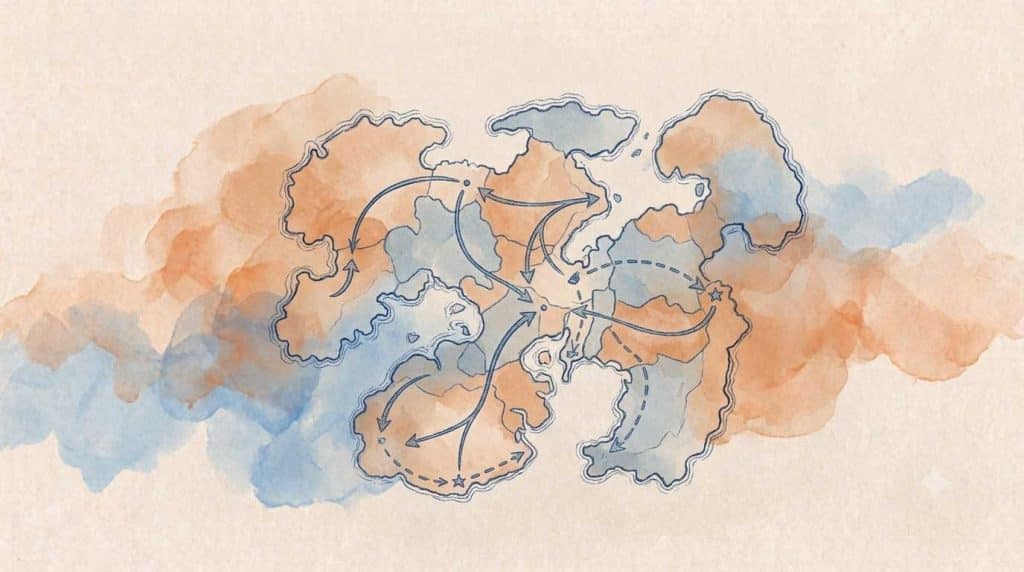
AGENTIC EVOLUTION VS. AGENTIC TRANSFORMATION
Investing in your existing infrastructure instead of rebuilding
None of this agentic speak means starting over. The loudest advice today is to tear your processes down, and that advice is wrong. The value you have built lives in your towns, your data and the way you operate, and throwing that away is the fastest way to lose it.
The real move is to modernize what you already have. You keep your towns and how they work, connect them with the infrastructure agents need, and govern the whole network so it runs safely. Same business, now operating as an agentic enterprise.
GLOSSARY
The words you'll keep hearing, in plain terms
MANUFACTURER
AI Company (Developer and Provider)
The company that builds the engines, the products, or both. Anthropic makes Claude. OpenAI makes ChatGPT. Salesforce builds Agentforce and runs it on models from several makers, including ones it did not build itself.
CAR BODY
AI Product
What you open and type into: the Claude app, ChatGPT, Copilot. It wraps the model in a chat window, memory and a few tools so you can get work done with it. These products stop short of being agents though. No charter, no limits set in advance, no reach into your systems, and nothing happens until you ask.
ENGINE
AI Model
The engine inside the product, and the version matters. Claude runs on Opus or Sonnet, ChatGPT runs on GPT-5. Same maker, different thing: you talk to the product, the model does the work. You pick the engine for the trip and swap in a better one as needed for the complexity of the task.
An open standard for agents talking directly to each other, so an agent built on one platform can find another, hand it a task and get the result back. MCP connects an agent to your tools and data; A2A connects agents to each other.
Software that can reason, decide and act toward a goal, rather than answering one prompt at a time.
THE CAR BUILT AROUND THE ENGINE
Salesforce’s platform for building and running AI agents across sales, service and more.
Diabsolut’s managed service for keeping Agentforce agents safe and accountable once they are live: the limits they run inside, the monitoring that catches problems early, and the audit trail that proves what happened.
An operating model where your people and your AI agents run the business together. It is a direction reached through deliberate steps, not a switch you flip.
THE COUNTRY
A defined way for one system to ask another for data or to do something. Your APIs are the roads already built between your systems, each one laid deliberately for a particular route.
THE ROADS YOU ALREADY BUILT
Technology carrying out a fixed sequence of steps with less manual effort. The difference from an agent: automation follows the path you drew for it and stops when it meets something you did not anticipate. An agent is given the outcome instead of the path, and works out the steps as conditions change.
How much an agent is allowed to do without checking in. Set deliberately for each one: full speed on routine work, a pause before anything sensitive.
THE CRUISE CONTROL
Routes a request to the right agent or tool, calls what it needs and assembles the response.
THE DISPATCH CENTRE
A model that scores how disciplined, repeatable, and predictable an organization’s processes are, measured against a defined, ordered set of maturity levels. In plain terms: how good and how consistent are we at doing X today, and what does moving up a level take?
THE TRAFFIC RULES FOR THE WHOLE COUNTRY
The plain-language document that defines an agent before it is built: its purpose, its users, what it can and cannot do, where a person signs off, and how success gets measured.
THE BLUEPRINT
Built from modular parts you can swap or recombine without rebuilding the whole, so you can change the model, a tool or a data source as things improve.
The single layer that runs the agentic system: registry, orchestration, governance and monitoring in one place.
THE ROAD NETWORK, ITS RULES AND ITS DISPATCH
Everything an agent draws on, and it rarely sits in one place: records in your CRM and ERP, documents, emails, call transcripts, knowledge articles. Structured data lives in defined fields and tables, so it is easy to query and easy to trust. Unstructured data is everything free-form, like a PDF or a Slack thread, which holds a lot of knowledge but needs work before an agent can rely on it.
THE FUEL
Salesforce’s data platform, formerly Data Cloud. It brings records, documents and streams into one place agents can draw on, and connects to systems like Snowflake without copying the data across. It works with data at different levels of cleanliness, so agents can start before everything is tidy.
The systems of record agents read from and write to, like your CRM, your ERP and your data lake, so every agent works from the same facts.
THE TOWNS
The controls on a single agent: which data it can reach, which actions it can take and when it has to stop and ask. Written into its charter and enforced while it runs.
THE DRIVING RULES
The rules that apply across every agent you run, plus the monitoring and enforcement that keeps them followed as you add more.
THE TRAFFIC RULES FOR THE WHOLE COUNTRY
Hard limits set in advance that an agent cannot cross whatever it decides: actions it may not take, data it may not touch.
THE LANE LINES
The points where a person reviews, approves or takes over. Your people set the destination and stay accountable, and the agent hands back when judgment is needed.
THE STEERING WHEEL
A framework describing stages of capability, used to place where you stand today and map the path forward.
An open standard for connecting agents to tools and data, so an agent can reach a system without a custom integration built for each one.
THE HIGHWAYS
Data about your data: what a field means, where it came from, who owns it and how it relates to everything else. It is how an agent works out which data to trust and how to use it correctly.
A system trained on an enormous amount of text to predict what comes next, which is how it drafts, explains, reasons and writes code.
THE ENGINE
Salesforce’s integration platform, and what makes your existing systems reachable by agents without rebuilding them. Its Agent Fabric capability adds a registry of every agent running, routing between them, one place to set the rules and a live view of what they are doing, including agents built outside Salesforce.
Seeing what your agents are doing and how well they are doing it: traces of each session, quality scores, and alerts when something drifts.
Coordinating several agents and systems toward one outcome, deciding what runs, in what order, and with what data.
The written rules that apply across your agents: what each may access, which actions need a person, what has to be logged, how exceptions are handled. Policies are the statement; governance is how they get enforced.
THE HIGHWAY CODE
The catalogue of every agent running in your business, what each one does and who owns it. Without one, nobody can say how many agents you have.
Adjusting an agent against real traffic once it is live: the prompts, the data it draws on, the limits, sometimes the model itself. Agents rarely perform at their best on day one, and tuning is what closes the gap between a demo and a dependable run.
Where your people meet the agent: a chat in Slack, a record page in Salesforce, an email inbox. An agent is only as useful as the place people already work.
The people who set the destinations, supervise the work and take the wheel when judgment matters, plus the employees and customers your agents serve alongside.
THE DRIVERS AND THE PEDESTRIANS
The live view of agents at work: which are running, what they are touching, and where each request travelled.
THE DASHBOARD
Enough theory. Now watch one on the road.
Book a demo and see how an agent moves inside a system like yours.